SEO + Ecommerce Planning
Tix 4 Tonight
Redesigned Tix 4 Tonight's entertainment ticket website into a stronger SEO and discovery platform while exploring a future B2C ticket purchasing flow.
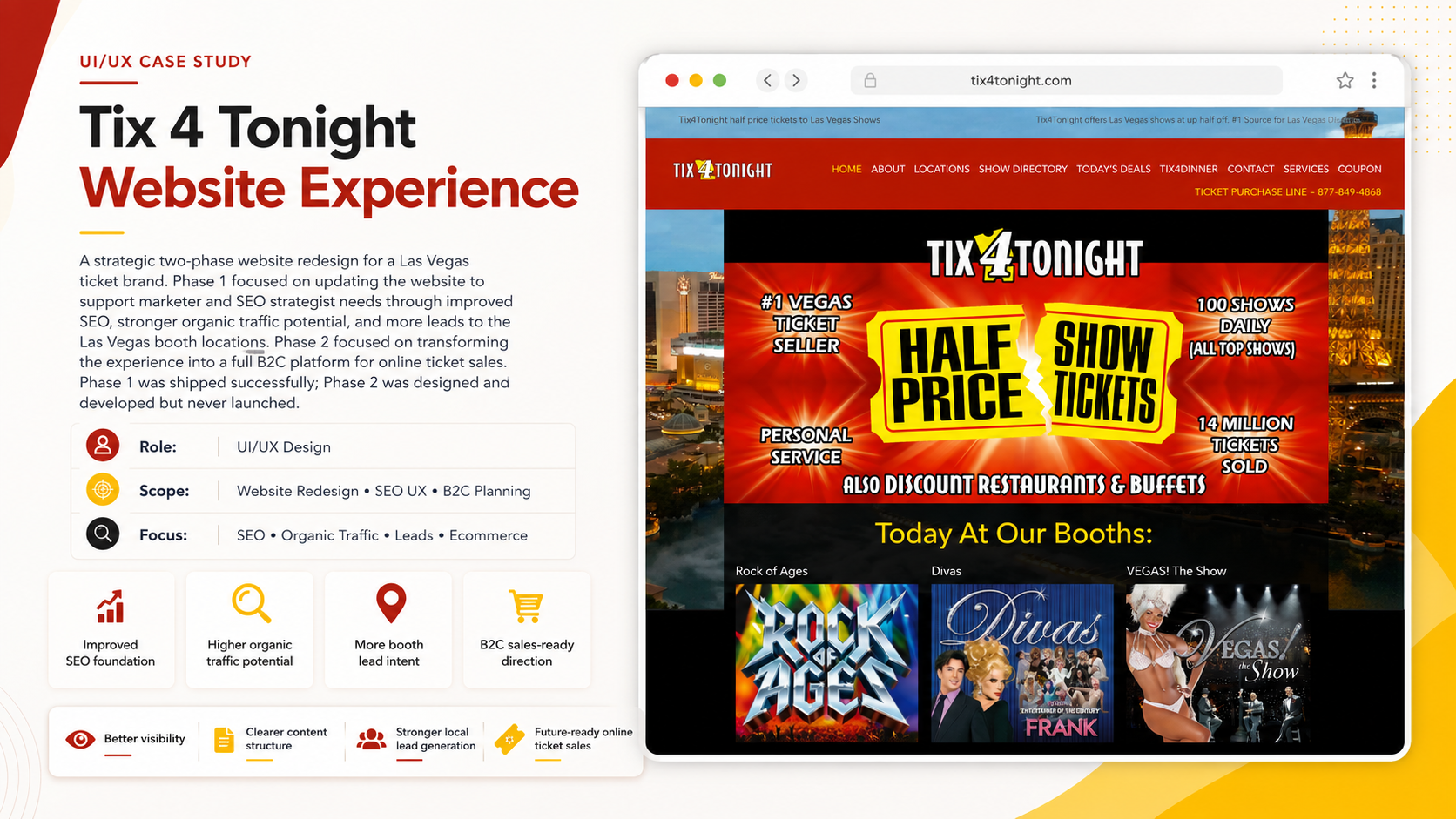
Tix 4 Tonight needed stronger online visibility and show discovery without immediately disrupting the booth-based sales model that drove its Las Vegas ticket business.
The redesign improved the website's digital presence, supported more organic discovery, increased sales inquiries, and defined a future B2C ecommerce direction even though that phase did not ship.
Quick Context
Tix 4 Tonight was a Las Vegas discount ticket company helping customers find entertainment deals and make purchase decisions once they arrived in Las Vegas.
I was hired as a web developer to help redesign and develop their ecommerce website experience. The project team was small and focused, consisting of myself, a content web writer, and an SEO specialist.
The original goal was not to launch a full online ticketing platform right away. Tix 4 Tonight first wanted a stronger SEO-friendly website that could increase organic traffic, improve discoverability, and support more customer interest around Las Vegas shows.
The business was cautious about moving too quickly into B2C ecommerce because there was concern that online purchasing could reduce foot traffic to their physical booths.
As competitors grew and customer expectations shifted, the business later explored a direct B2C ticket purchasing experience. Low-fidelity and high-fidelity ecommerce screens were created for this second phase, but the B2C platform was never fully shipped.
The final impact of the project was a stronger digital presence, improved website traffic, and increased sales inquiries that were directed back to the physical booths for follow-up and purchase support.
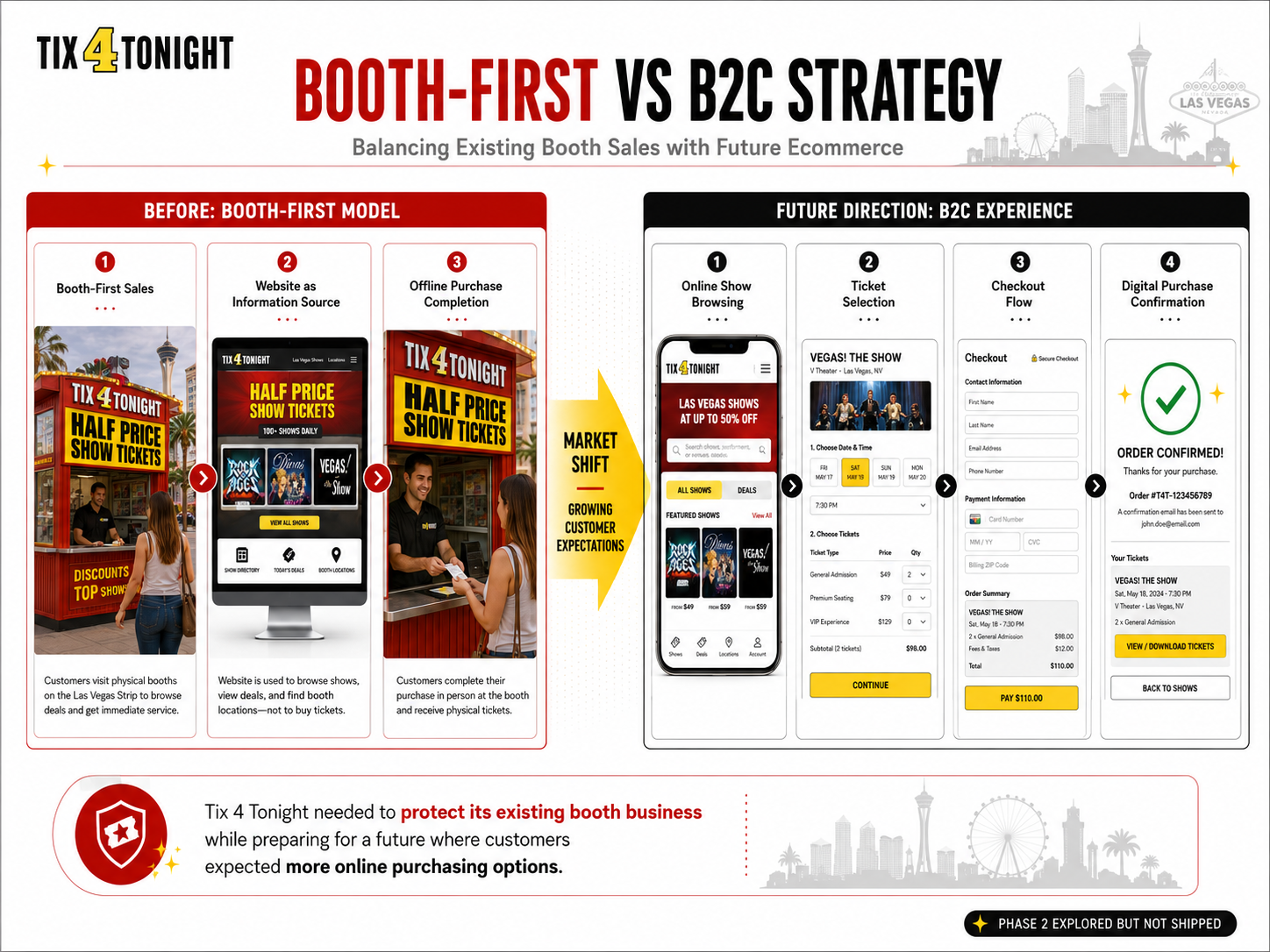 Booth-first to B2C strategy
Project Type
This was a website redesign with SEO, content, ecommerce planning, and light UI/UX strategy.
It was not a full UX research project. It was a practical business-focused redesign where UX thinking was applied to information architecture, content structure, user flow, purchase intent, and future ecommerce planning.
My Role
My role focused on web development, website structure, frontend implementation, ecommerce planning support, and translating business requirements into usable website flows.
I worked closely with:
- A content web writer, who helped shape show-related content and customer-facing page copy.
- An SEO specialist, who guided keyword strategy, organic search improvements, and content structure.
- Business stakeholders, who provided insight into booth operations, customer behavior, and sales concerns.
The Core Challenge
Tix 4 Tonight had a strong offline business model, but its website needed to become more than a basic information source.
The business wanted to grow online visibility without disrupting the physical booth sales model that had supported the company for years.
The website needed to attract more visitors, answer more customer questions, and generate more purchase interest while still guiding customers toward the booth-based sales process.
Later, when competitors began offering stronger online options, the company realized that a direct B2C experience would likely become necessary. However, this shift required careful planning because it changed the business model from booth-first sales to a more self-service digital purchase flow.
Problems
The Website Was Not Strong Enough as an SEO Platform
The first major problem was visibility. The company operated in a competitive Las Vegas entertainment market where customers often searched online before deciding which shows to see or where to buy tickets.
The website needed to better support organic discovery around Las Vegas shows, discount tickets, same-day tickets, booth locations, show categories, customer questions, ticket availability, and purchase intent.
For a business that depended on tourism and time-sensitive decision-making, SEO visibility was not just a marketing goal. It was part of the customer journey.
A customer might search for discounted tickets before arriving in Las Vegas, while walking the Strip, or while comparing show options from a hotel room. If Tix 4 Tonight was not visible during those moments, competitors had a better chance of capturing that customer.
The Business Relied Heavily on Physical Booth Traffic
Tix 4 Tonight’s business model was built around physical locations on the Las Vegas Strip. The booths were a major part of the brand experience and sales process.
This created a unique challenge. The website needed to create digital demand, but not replace the booth experience too quickly.
Stakeholders were concerned that launching direct online purchasing might reduce foot traffic to booths. Because the booths were central to customer interaction and sales conversion, the business wanted to protect that model.
The first version of the redesign had to support a hybrid journey:
- Customer searches online.
- Customer discovers shows or ticket options.
- Customer submits an inquiry or gains interest.
- Customer is directed toward a booth for purchase completion or follow-up.
The website became a lead generation and education layer rather than a fully self-service checkout experience.
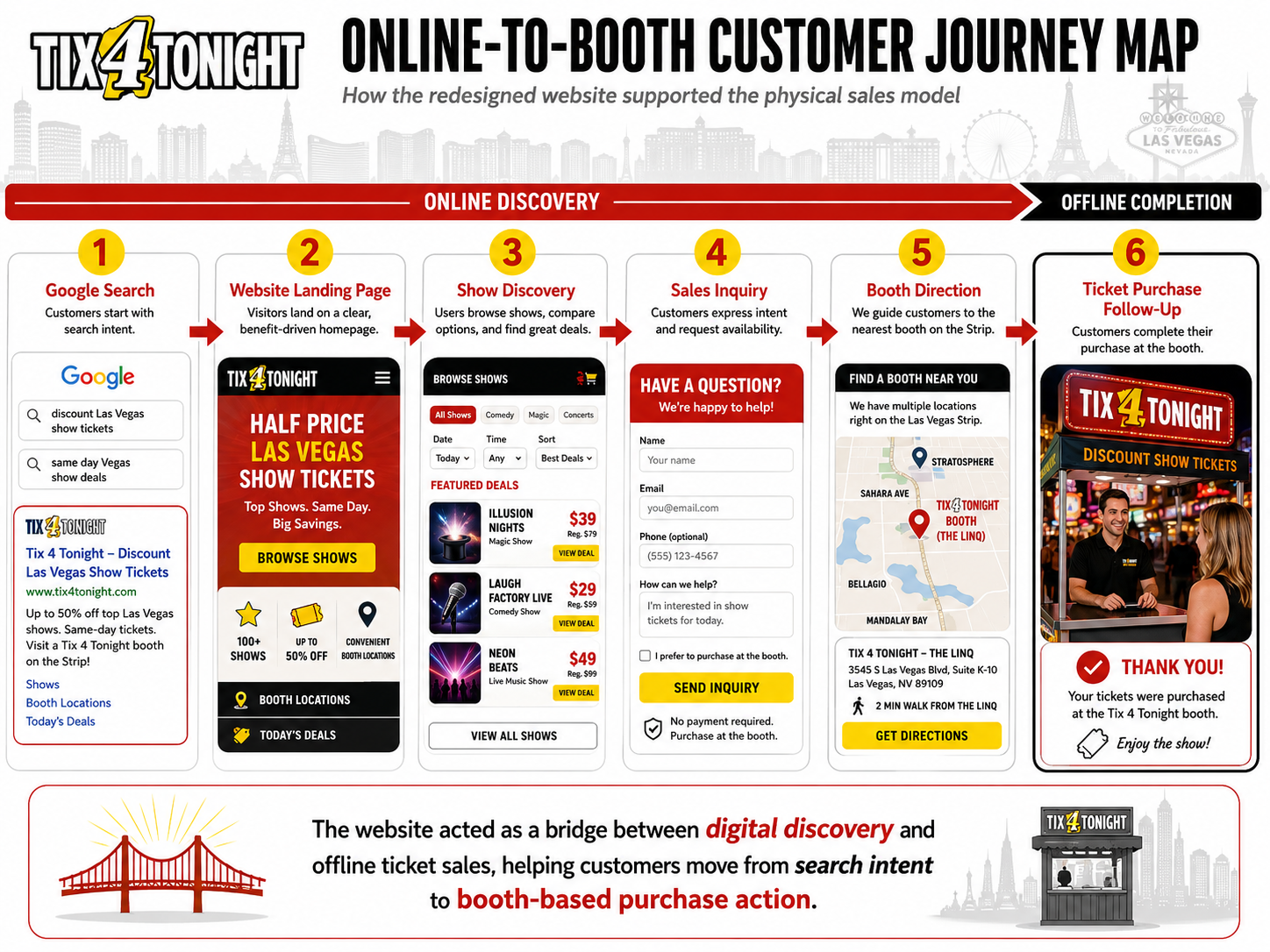 Online search to booth customer journey
Customers Needed Clearer Paths to Show Information
A customer looking for Las Vegas tickets is often making a quick decision. They may not know exactly what show they want, which category fits their group, where the nearest booth is, or how the discount ticket process works.
The website needed to make this experience easier by improving show discovery, content clarity, navigation structure, calls to action, booth-related information, and purchase inquiry paths.
The challenge was not only technical. It was also about reducing uncertainty.
Customers needed to quickly understand what Tix 4 Tonight offered, why it was useful, and what step to take next.
Competitor Growth Increased the Need for B2C Ecommerce
As competitors grew and online purchasing became more common, the business recognized that delaying B2C ecommerce could become a risk.
Customers were becoming more comfortable buying tickets online, comparing prices, and expecting faster checkout options.
Tix 4 Tonight eventually began exploring a B2C ticket purchase flow. This included planning low-fidelity and high-fidelity screens for a more direct ecommerce experience.
The challenge was that the company had to balance innovation with business risk. A new B2C flow could open online revenue, but it could also affect the booth-first model that the company had historically depended on.
Decisions
Start With a Search-Friendly Redesign Before Full Ecommerce
The first major decision was to focus on strengthening the website as an SEO and discovery platform.
Rather than immediately pushing the business into a full ecommerce model, the redesign focused on improving the digital foundation first.
This included cleaner website structure, more search-friendly pages, improved content hierarchy, better show and service discoverability, clearer calls to action, stronger support for organic traffic, and better alignment between website visitors and booth sales.
This decision respected the business reality. The company wanted online growth, but it was not ready to fully shift away from booth-based selling.
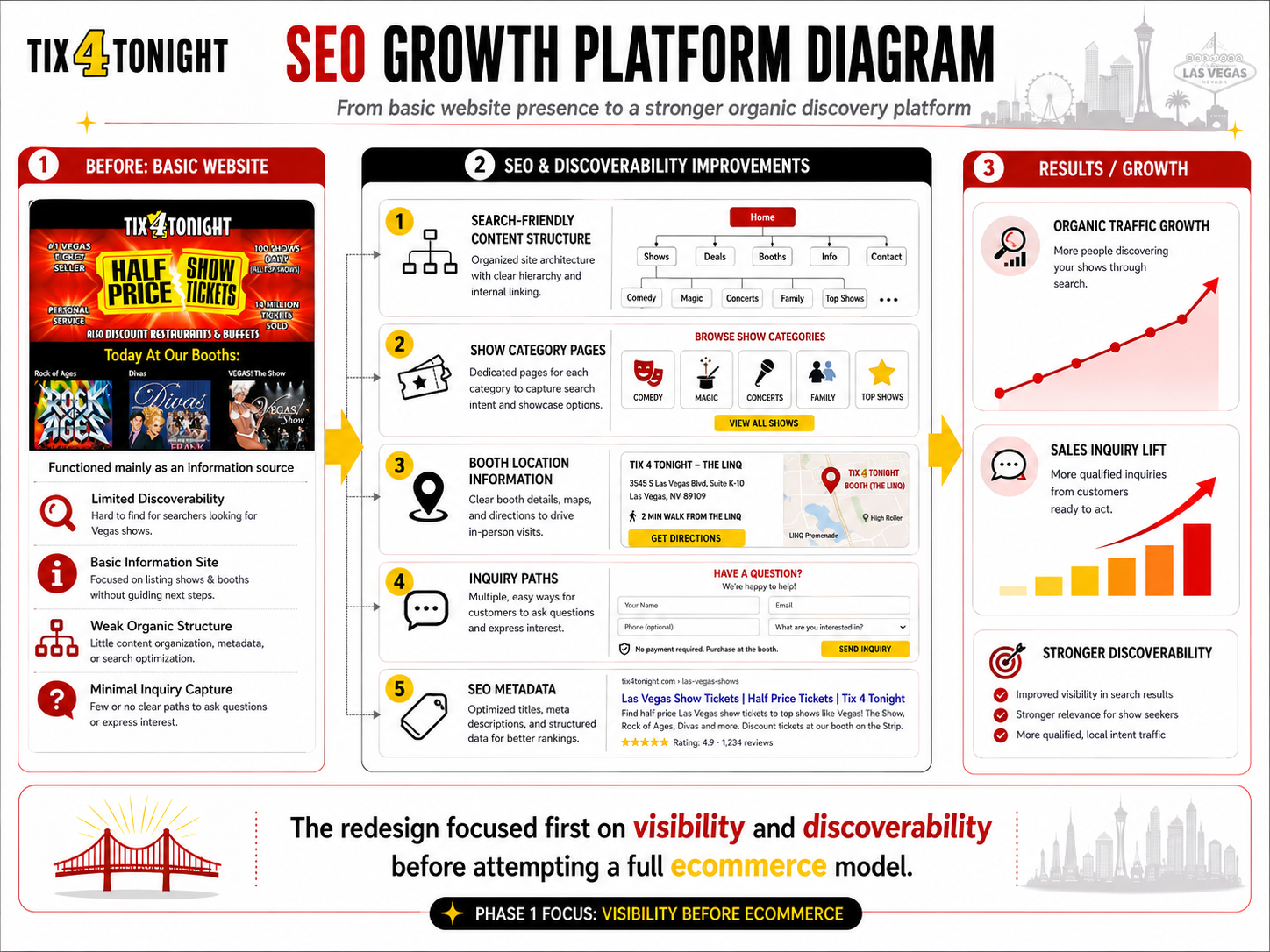 SEO growth platform structure
Build the Website Around Customer Intent
The website structure needed to reflect how customers actually think when searching for Las Vegas entertainment.
Instead of treating the site as a simple brochure, the redesign approached it as a discovery journey.
Customer intent was likely shaped by questions such as:
- What shows are available tonight?
- Where can I get discounted tickets?
- How does the ticket process work?
- Where is the nearest booth?
- Can I buy or reserve tickets online?
- Is this a legitimate discount ticket provider?
- What types of shows are available?
The website needed to make these answers easier to find. This influenced page structure, content placement, navigation, and calls to action.
Use Content and SEO as Part of the User Experience
Because the initial goal was organic growth, content was not treated as a separate marketing task. It became part of the user experience.
The content writer and SEO specialist helped shape a website that could attract traffic while also guiding users toward useful next steps.
The redesign supported content areas that could help users understand available show categories, ticket options, booth locations, how discounted tickets worked, why buying through Tix 4 Tonight was convenient, and what customers should do next.
Higher traffic alone would not be enough. Visitors needed to understand the value quickly and move toward an inquiry or booth visit.
Preserve the Booth Sales Model While Improving Digital Conversion Paths
The website did not immediately replace the physical sales journey. Instead, it supported it.
This meant designing pathways that could increase purchase interest while still directing customers toward booth-based follow-up.
Key conversion points included show inquiry paths, clear calls to action, booth location guidance, customer support direction, purchase interest forms or prompts, and content that encouraged customers to take the next step offline.
This decision helped reduce stakeholder concern. The website could increase demand without immediately forcing a complete operational change.
Explore a Future B2C Ecommerce Flow in Phase 2
As competitors continued to grow, Tix 4 Tonight began exploring a more direct ecommerce experience.
For this phase, low-fidelity and high-fidelity screens were created to imagine how a customer might browse shows, select tickets, and move toward online purchase.
The proposed B2C flow introduced a more self-service model:
- Customer lands on the website.
- Customer browses available shows.
- Customer selects a show.
- Customer reviews ticket details.
- Customer begins checkout.
- Customer receives confirmation or next-step instructions.
Although this phase was not shipped, the design work helped the business visualize what a future online ticketing model could look like.
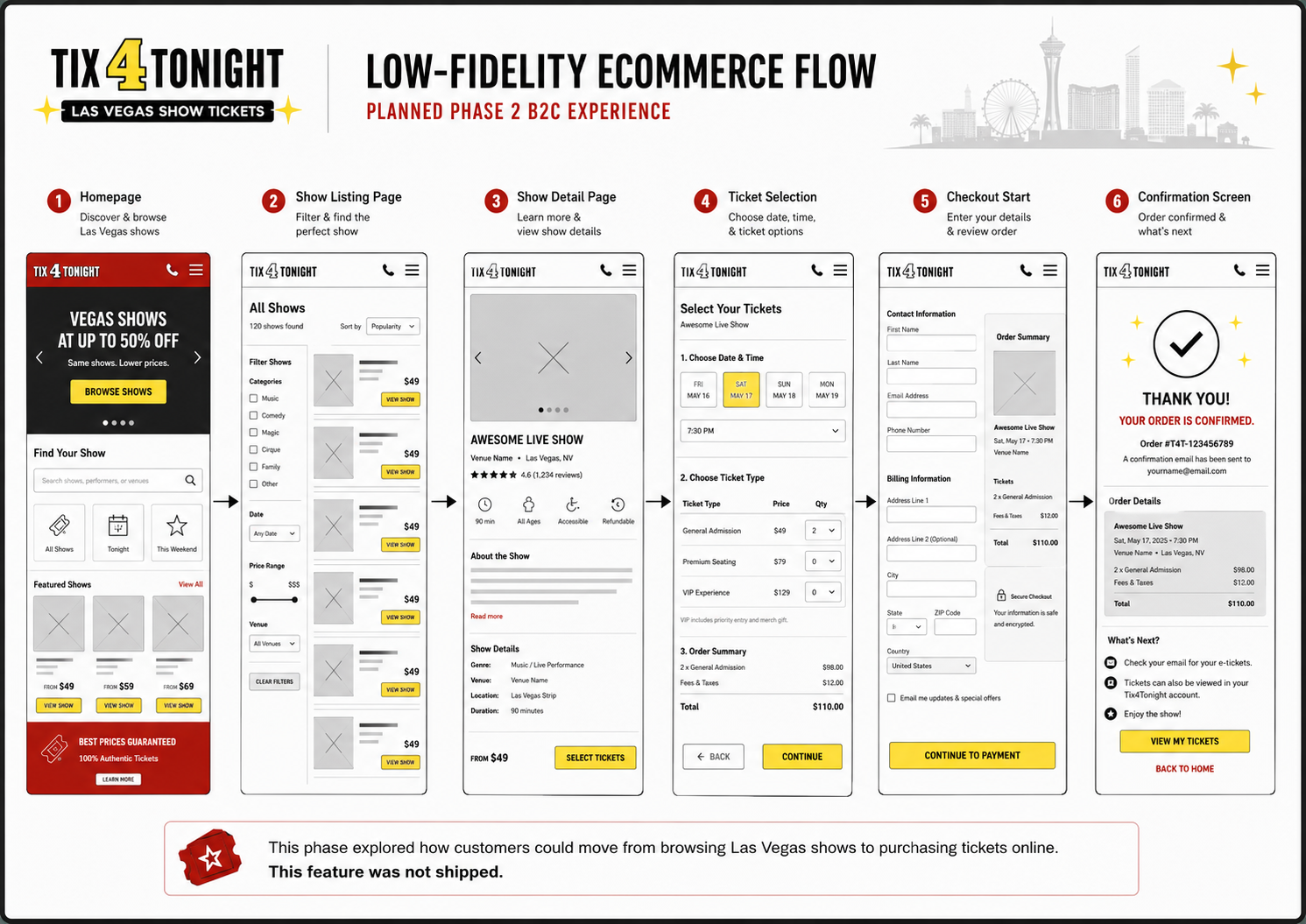 Future B2C ecommerce wireframes
Result
Website Traffic Increased
The SEO-focused redesign helped improve organic web traffic. The updated platform gave Tix 4 Tonight a stronger foundation for search visibility and customer discovery.
While exact metrics are not available for this portfolio case study, the directional result was positive. The website attracted more visitors and became more useful as a digital entry point for customers researching Las Vegas show tickets.
Sales Inquiries Increased
The website generated a higher rise in inquiries related to sales purchases.
Since the business had not fully shifted into B2C ecommerce, these inquiries were directed toward the physical booths or sales follow-up process.
This was an important result because it showed that the website was creating more customer intent, even without a full online checkout experience.
The Website Became a Stronger Bridge Between Online Search and Offline Sales
Before the redesign, the website functioned more like a basic digital presence. After the redesign, it became a stronger bridge between online discovery and booth-based ticket sales.
This gave the business a more useful digital funnel: search visibility, website visit, show interest, sales inquiry, and booth follow-up.
The B2C Direction Was Defined, Even Though It Was Not Shipped
Phase 2 did not launch, but it still created value.
The low-fidelity and high-fidelity ecommerce screens helped define what a future B2C version of the platform could become. This included early thinking around show browsing, ticket selection, purchase flow, and digital conversion.
The work showed how Tix 4 Tonight could eventually evolve from a booth-supported ticket company into a stronger online ticketing platform.
Reflections
This project taught me the importance of designing around business transition, not just interface improvement.
Tix 4 Tonight did not need a full ecommerce transformation on day one. The business needed a safer bridge between its existing booth-based model and the digital expectations of modern customers.
One of the biggest lessons was that a successful redesign is not always about launching every feature. Sometimes the right first step is building a stronger foundation, improving visibility, validating demand, and helping stakeholders become more comfortable with the next phase.
I also learned how important it is to balance SEO, content, and UX. For this project, search visibility was part of the customer experience. If customers could not find the website, they could not enter the journey. If the content was unclear, they would not take action. If the calls to action were weak, the business would not see value from the added traffic.
In future projects, I would push for clearer measurement from the beginning, including baseline traffic, conversion tracking, inquiry attribution, and booth referral tracking.
I would also recommend validating the B2C ecommerce concept earlier through a smaller pilot, such as limited online reservations, inquiry-based ticket holds, or a small category of online-purchasable tickets. This could help reduce stakeholder fear while still moving the business toward a more competitive digital model.
The project remains a strong example of how even a simple redesign can support business growth when the website is treated as part of a larger customer journey.