Website + Ecommerce UX
The Harman Press
Redesigned a legacy print company's website into a stronger lead-generation channel and planned a B2C print ordering platform that balanced customer simplicity with production quality control.
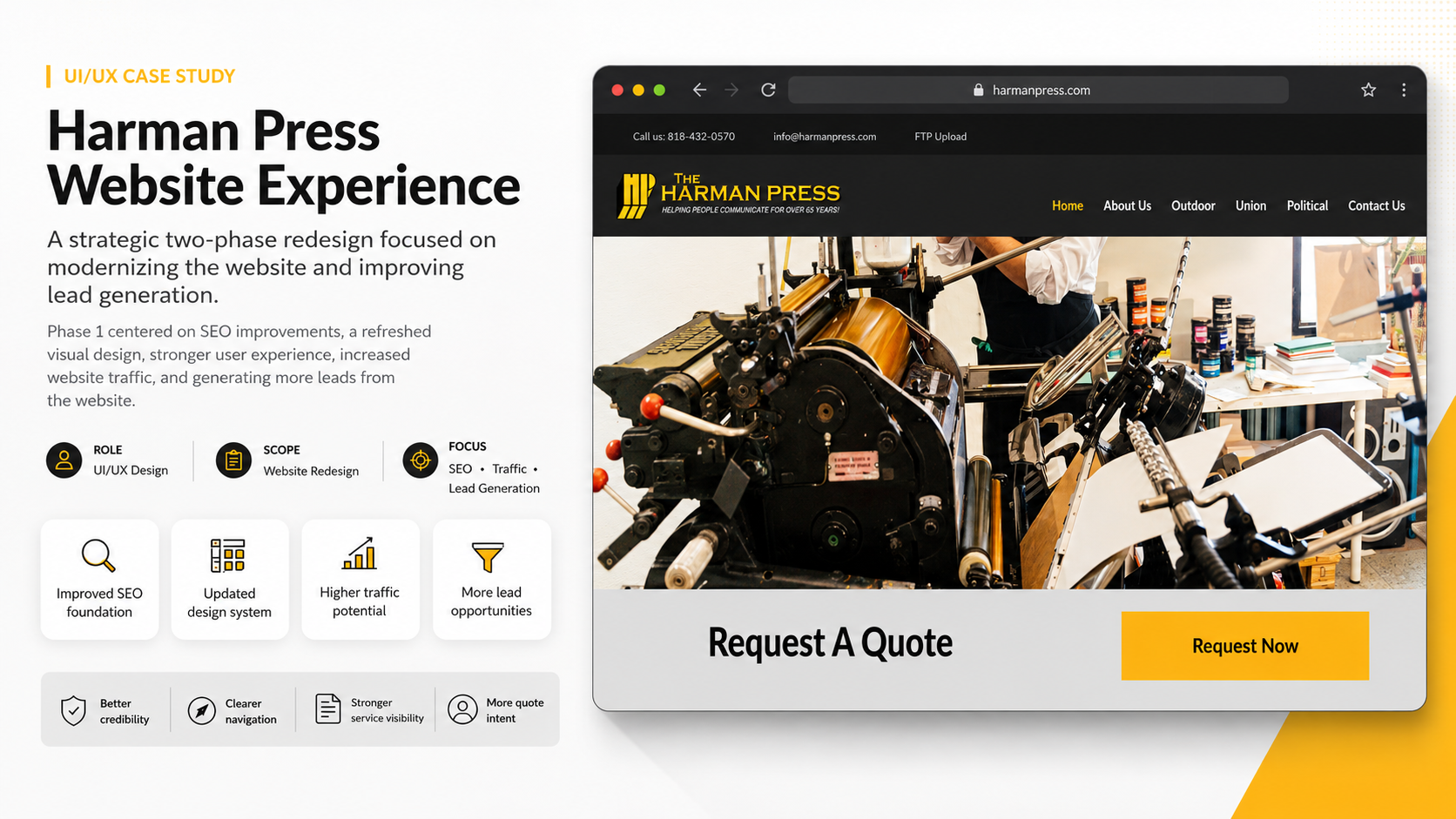
The Harman Press had decades of credibility, but its website functioned mostly as a basic contact presence and did not communicate service depth, generate enough leads, or prepare the business for online print ordering.
Phase 1 increased lead generation from roughly 2-3 monthly form leads to around 40-50 monthly leads and helped traffic grow from early baseline levels to up to 5,000 unique monthly visitors.
Quick Context
The Harman Press was a family-owned printing business with three generations of history, operating since 1943. The company had built its reputation through high-quality commercial printing for large B2B clients, including major entertainment studios, radio stations, and corporate accounts.
Their services covered a wide range of print production needs, including envelopes, lithography, prepress, large format printing, bindery, and custom print work.
When I joined the project, the company’s website functioned mostly as a basic “Contact Us” presence. It communicated that the business existed, but it did not reflect the depth of their services, the credibility of their legacy, or the opportunity to attract a wider customer base.
My original role was as a Web Designer and Ecommerce Expert, with the goal of helping The Harman Press move toward a more modern digital experience. The project evolved into two major phases:
- Phase 1: Redesign and improve the existing website to generate more qualified leads.
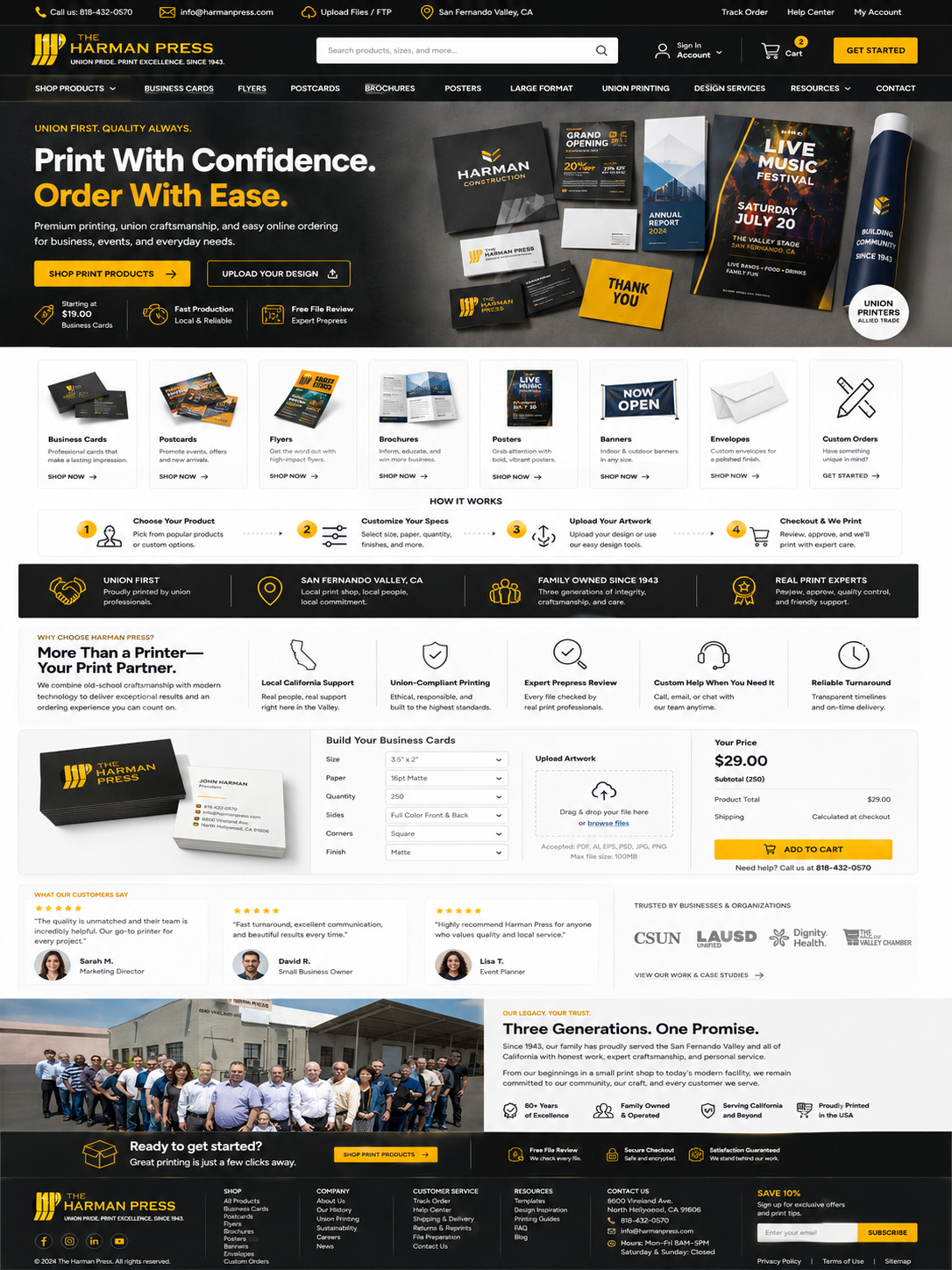
- Phase 2: Expand the website into a full B2C ecommerce print ordering platform where customers could order print products online.
The first phase successfully improved the company’s digital presence, search visibility, and lead generation. The second phase entered development, but did not ship due to COVID-19, company layoffs, and operational disruption.
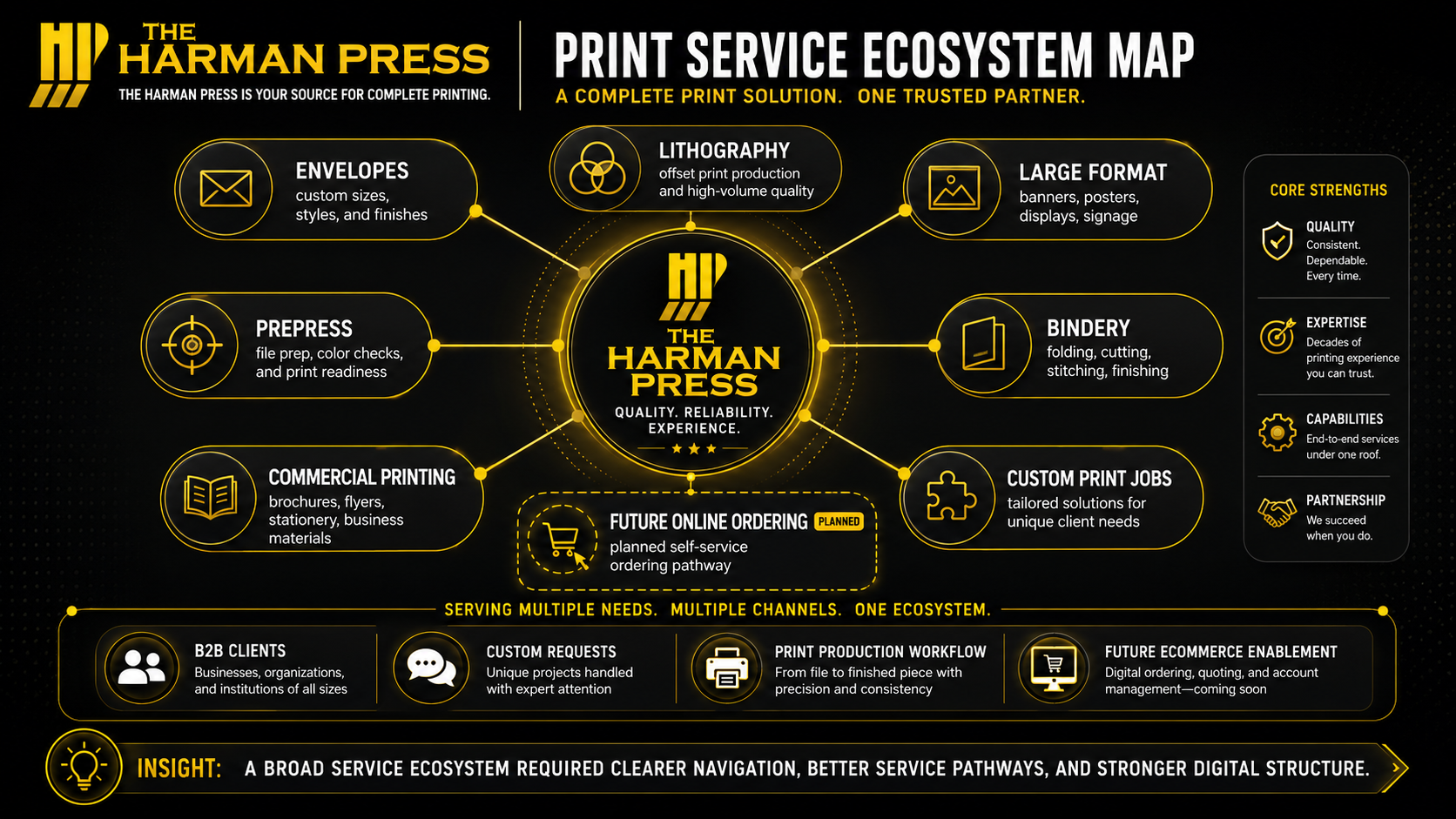 Print ecosystem and digital opportunity
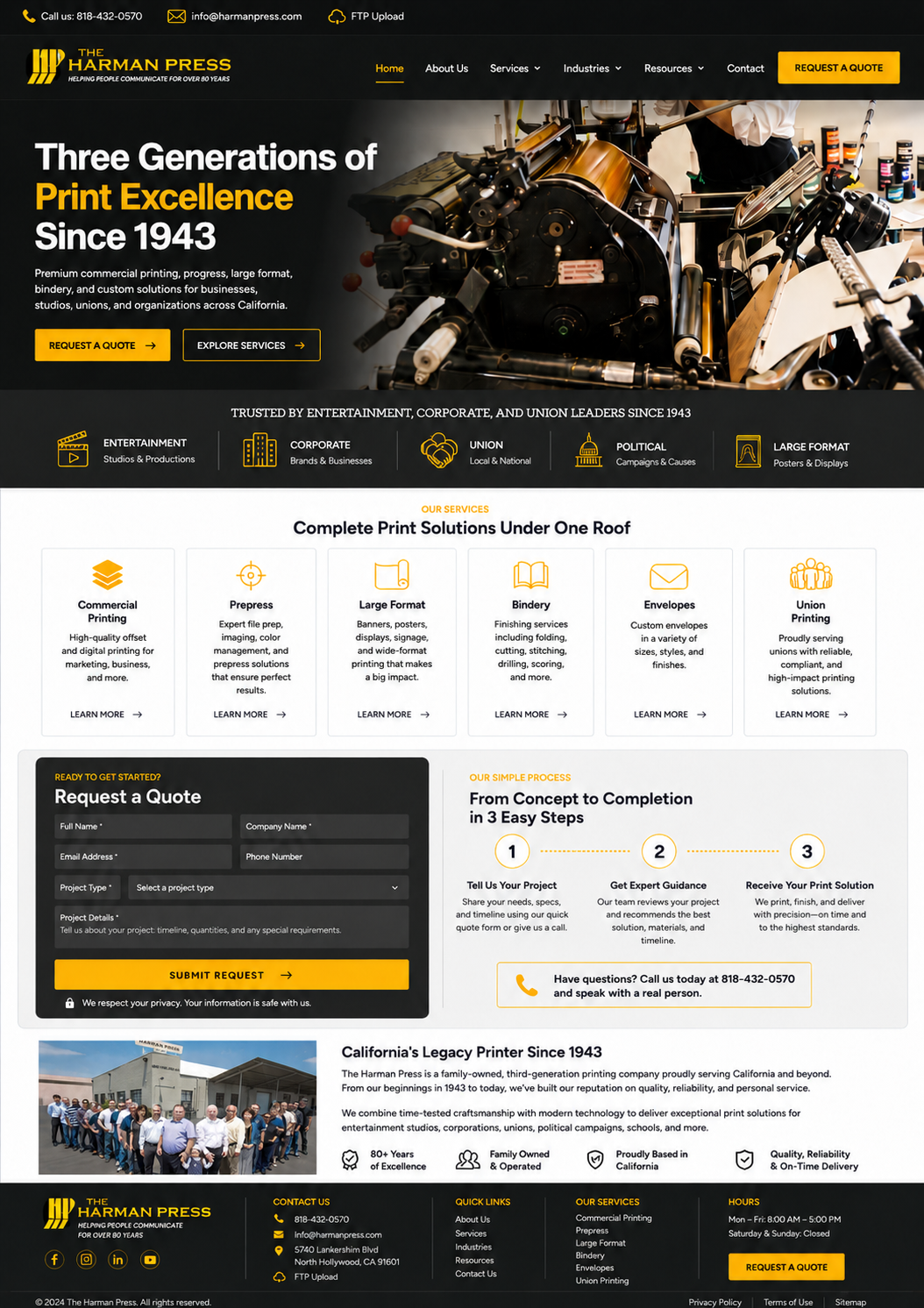
Problems
A Legacy Business With a Limited Digital Presence
The Harman Press had decades of industry credibility, but the website did not communicate that value effectively. The original site acted more like a static brochure than a business growth tool.
It did not clearly explain the company’s full range of services, guide customers toward relevant print products, or create confidence for new visitors who were not already familiar with the brand.
The main issue was not that the company lacked value. The issue was that the website failed to translate that value into a clear online experience.
Low Lead Volume
Before the redesign, the website generated only around 2 to 3 contact form leads per month. For a company offering a broad range of print services, this was a major missed opportunity.
The website was not supporting discovery, product education, or conversion. Visitors had little guidance on what The Harman Press could produce, why they should trust the company, or how to start a print request.
A Complex Service Offering That Was Difficult to Simplify
Printing is not always easy for customers to understand. Customers may know they need business cards, envelopes, booklets, signs, or marketing materials, but they often do not understand what a print shop needs to produce the job correctly.
The business wanted to move toward B2C ordering, but print production requires specific file standards, sizing, color setup, bleed, resolution, finishing requirements, and prepress checks.
The website needed to bridge two very different perspectives:
- What the customer thinks they are ordering.
- What the print team actually needs to produce the order correctly.
Stakeholder Concern Around Quality Control
One of the biggest fears from stakeholders was quality risk. The Harman Press had built its reputation over generations, and their concern was that a self-service B2C ordering system could lead to customers uploading low-quality files, choosing the wrong product settings, or misunderstanding print requirements.
The core stakeholder concern was clear: what if online ordering leads to low-quality print work and damages the company’s reputation?
This changed the project from a simple ecommerce build into a deeper UX and operational challenge. The solution had to protect the company’s production standards while making online ordering feel accessible for customers.
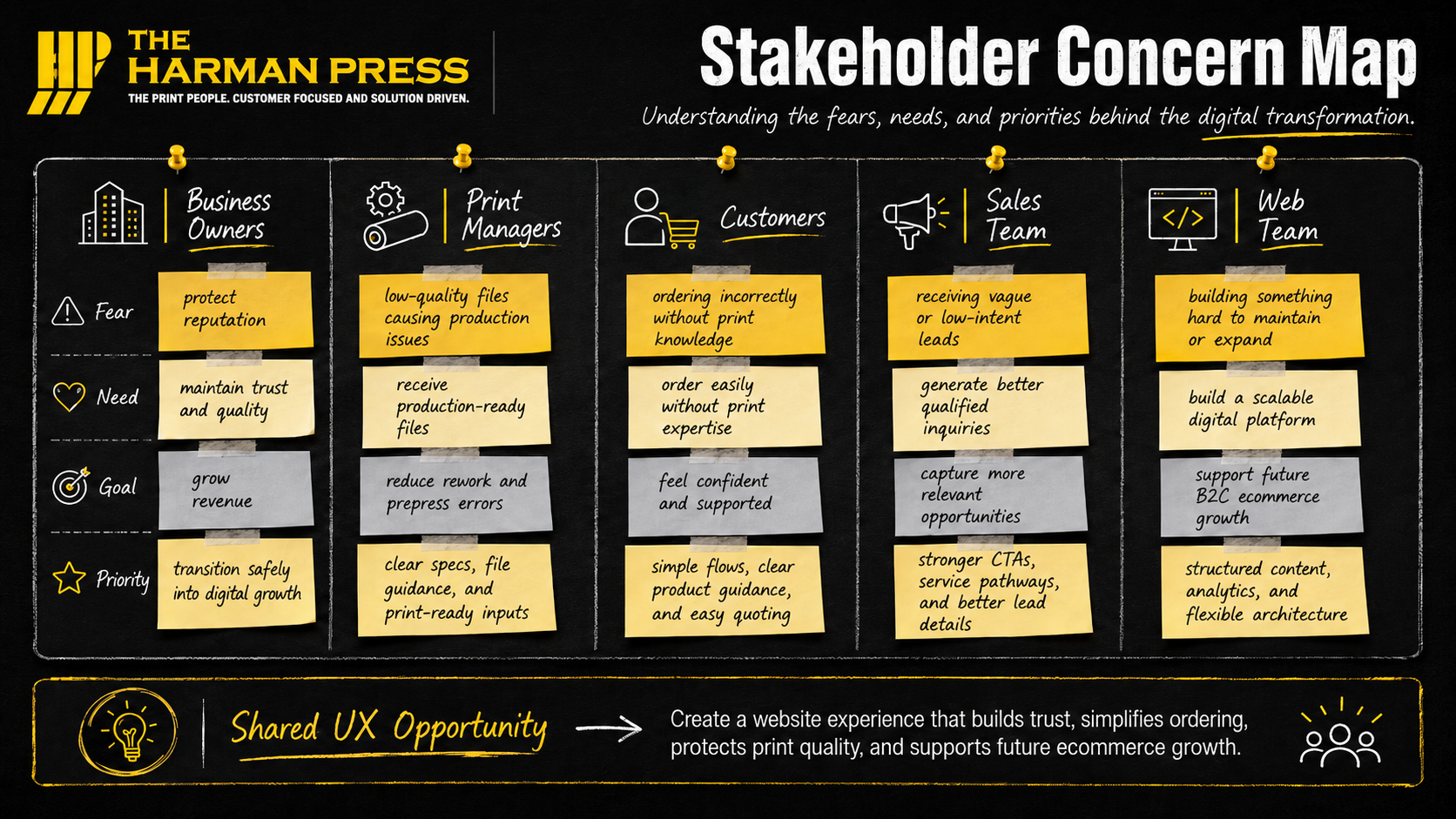 Stakeholder concern map
No Clear Measurement System
The original website did not have a strong measurement framework in place. There was limited visibility into traffic, customer behavior, search performance, or conversion patterns.
To improve the website meaningfully, I needed to define and track KPIs instead of relying only on visual improvements.
Decisions
Reposition the Website as a Business Growth Channel
The first major decision was to treat the website as more than a digital brochure. The redesign needed to support lead generation, search discovery, customer education, and future ecommerce expansion.
Rather than jumping directly into a full B2C ordering platform, I focused first on building a stronger foundation:
- Clearer service pages.
- Improved website structure.
- Better conversion paths.
- Stronger SEO fundamentals.
- Analytics tracking.
- Search performance monitoring.
- Product-focused lead generation.
This approach allowed the business to validate digital demand before fully committing to self-service ecommerce.
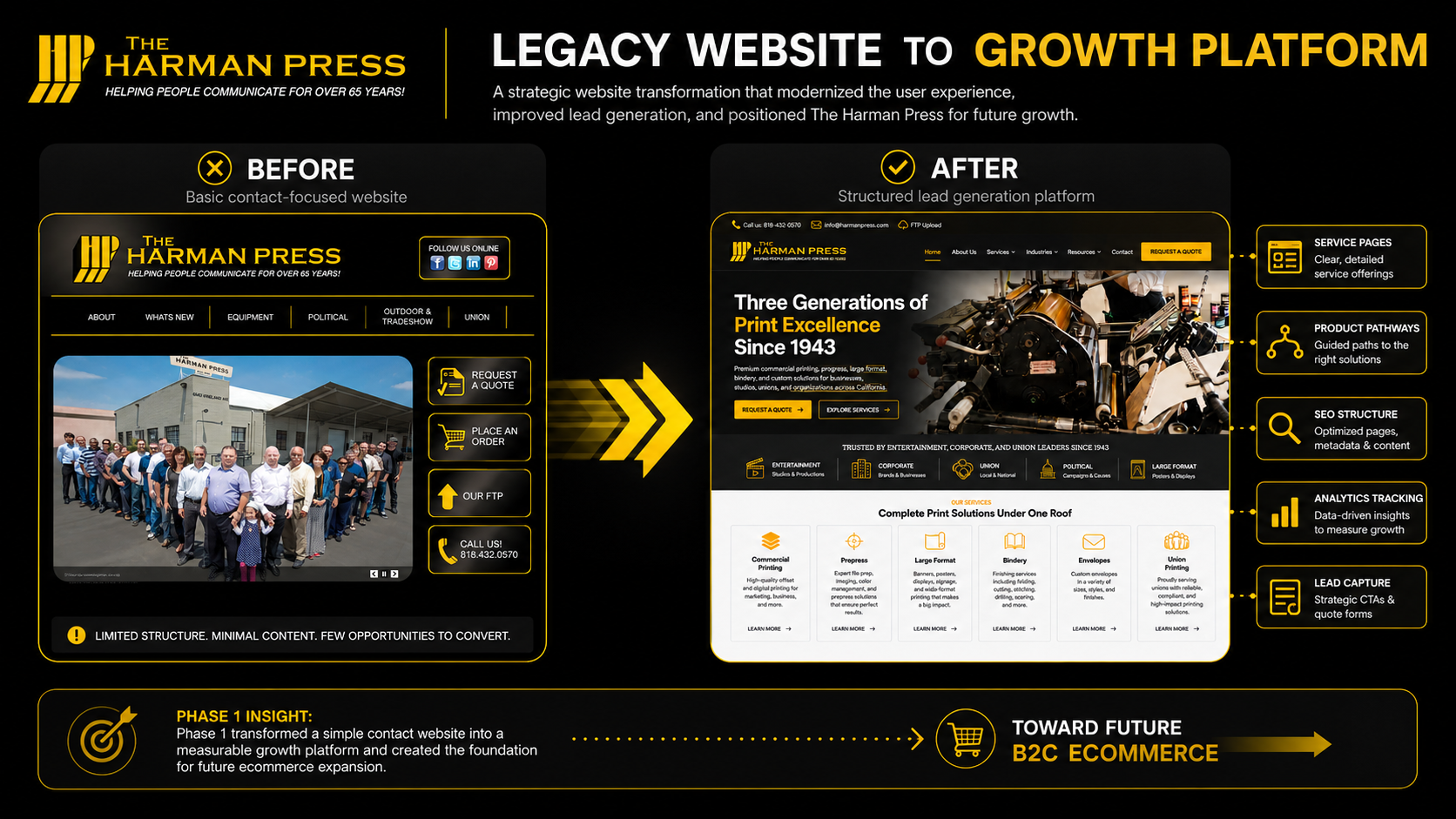 Before and after redesign comparison
Research the Printing Workflow From Both Sides
To design a useful experience, I needed to understand the printing business beyond the surface level. That meant researching the full customer journey and the internal production journey.
The research focused on how customers describe print products, what information customers usually understand, where customers get confused, what competitors were doing in online print ordering, what production teams need before a file is print-ready, and what managers were most concerned about.
This clarified that the future B2C platform could not simply copy a generic ecommerce flow. Print ordering needed its own UX structure, one that combined product selection, file education, guided configuration, and production safeguards.
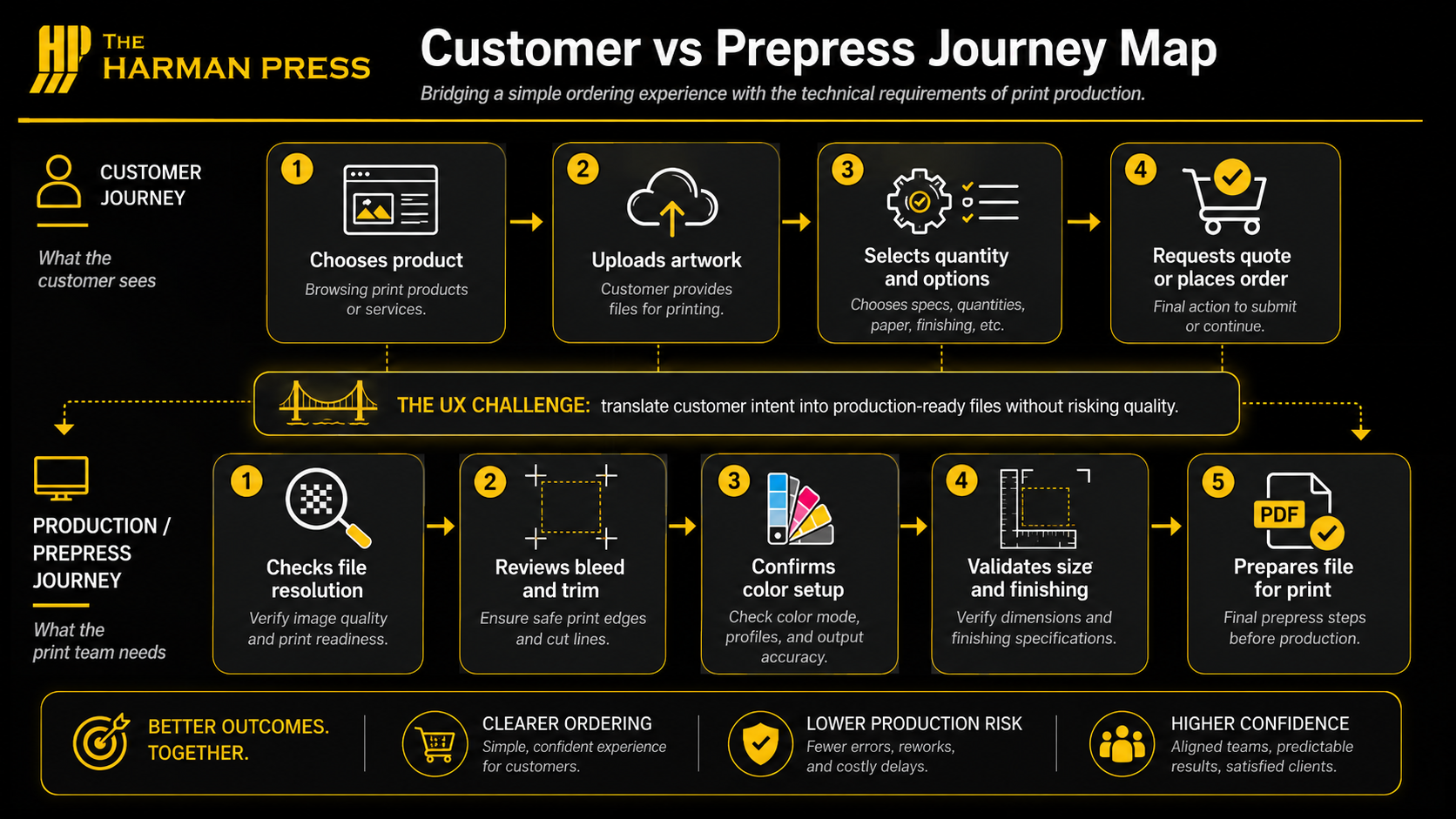 Customer-to-prepress journey map
Use Competitor Analysis to Shape the B2C Direction
I reviewed how other printing companies presented products, structured ecommerce flows, explained file setup, and guided customers through ordering.
The goal was not to copy competitors directly. The goal was to understand what customers were already being trained to expect from online print ordering.
Key patterns emerged:
- Customers need product categories that are easy to browse.
- Print specs need to be explained in plain language.
- Upload flows must include guidance and validation.
- Pricing and order steps should feel transparent.
- Trust signals matter because print quality is difficult to judge before purchase.
- Customers need reassurance that someone understands production quality.
Build Trust Before Pushing Self-Service Ordering
Because stakeholder confidence was a major concern, the project needed to ease the business into ecommerce rather than force a sudden operational shift.
Phase 1 became a validation phase. Instead of immediately launching a full ordering platform, the redesigned website improved the company’s ability to attract and qualify leads. This gave the team a way to observe customer interest, measure demand, and understand which print products generated the most inquiries.
The transition path became:
- Improve discoverability.
- Increase qualified leads.
- Learn what customers are requesting.
- Use that data to shape the B2C ordering experience.
- Gradually introduce self-service print ordering.
Improve SEO and Product Discoverability
The original website did not take full advantage of search intent. Customers searching for print services often look for specific products, not just a general printing company.
The redesign focused on making print services easier to discover through clearer structure and improved SEO. The website needed to support users who came in with different levels of intent, from specific product requests to broader B2B vendor evaluation.
Add Analytics and KPI Tracking
I added Google Analytics and Google Search Console so performance could be measured properly.
The core KPIs included monthly website traffic, unique visitors, contact form submissions, search visibility, product-related inquiries, lead volume growth, and engagement with print service pages.
Expand the Team as the Project Grew
The project began with me working independently across web design, ecommerce strategy, UX direction, and implementation planning. As the project expanded, the team grew to include myself as Web Designer and Ecommerce Expert, a Senior Web Developer, IT support, and a Lead Graphic Designer.
This shift reflected the project’s growth from a website redesign into a broader digital transformation effort.
Phase 2 Platform Direction
Although Phase 2 did not ship, the research and planning helped define what the future ecommerce platform needed to solve.
The platform needed product-based ordering flows, guided print specifications, clear file upload requirements, prepress education, customer-friendly product language, internal safeguards for production quality, a balance between automation and expert review, and trust-building moments throughout the order flow.
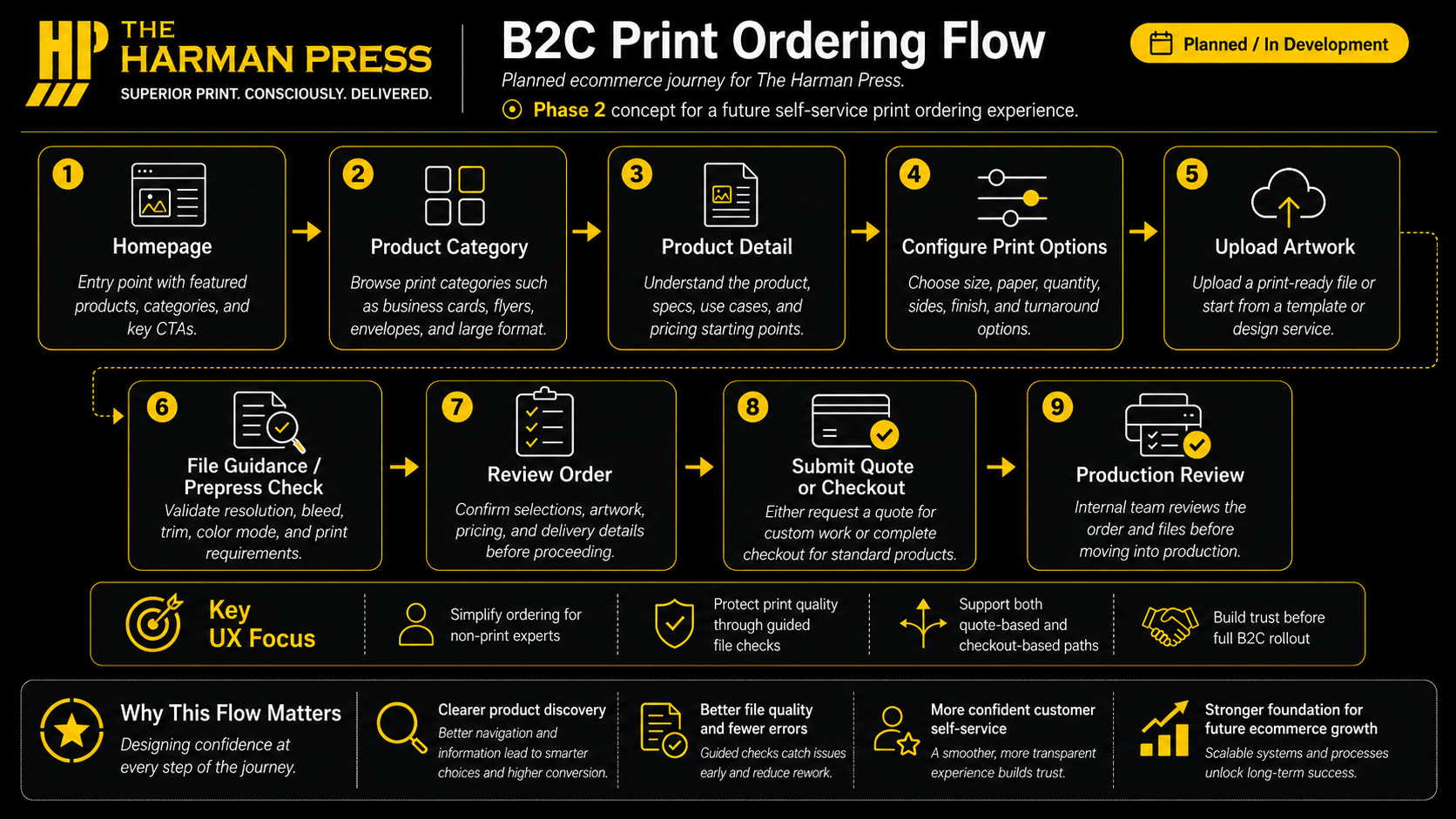 B2C print ordering flow
The unshipped second phase still provided value because it clarified the operational and UX requirements for a successful B2C print ordering system.
Result
The first phase of the redesign was successful.
Before the redesign, The Harman Press received around 2 to 3 contact form leads per month. After improving the website structure, SEO, service visibility, and conversion paths, the company began receiving around 40 to 50 leads per month for different print products.
SEO and website improvements also produced strong traffic growth. In the first quarter, the website was receiving around 50 to 100 users per month. By the third quarter, the site reached up to 5,000 unique monthly visitors.
The stronger lead volume helped validate that there was customer demand beyond the company’s traditional B2B relationships. Phase 1 created a slower and safer bridge toward B2C ecommerce by helping the team see which products customers were interested in and where additional education or production safeguards would be needed.
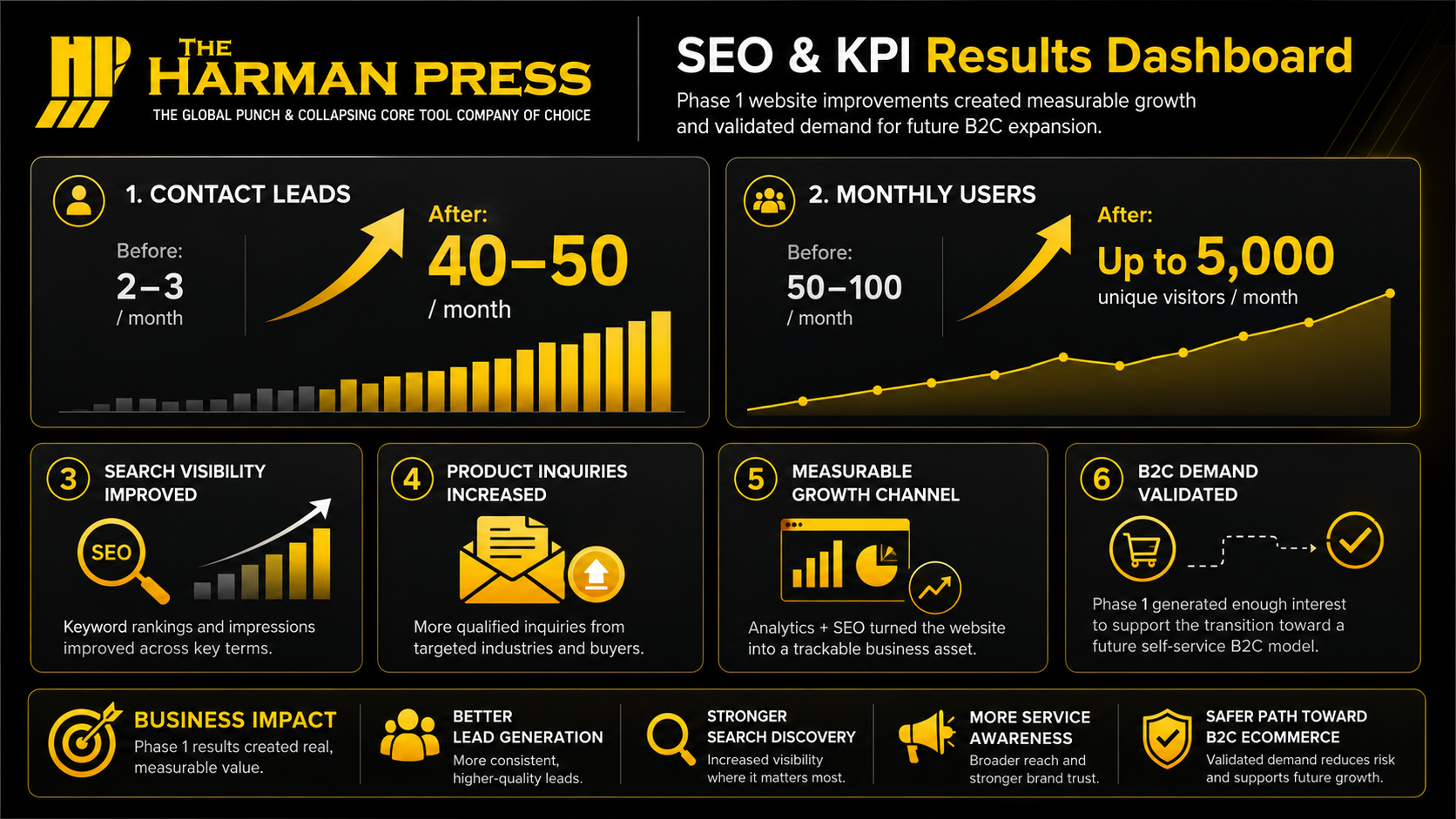 Lead generation and traffic results
Reflections
This project taught me that ecommerce design is not only about making products easy to buy. In specialized industries like printing, ecommerce also has to protect the quality of the final output.
The biggest lesson was understanding the gap between customer confidence and production reality. Customers want ordering to feel simple, but the business needs the right files, specs, and expectations to produce high-quality work. A successful print ordering experience has to guide the customer without overwhelming them.
I also learned the importance of earning stakeholder trust. The team’s concern about damaging the company’s reputation was valid. The Harman Press had spent generations building credibility, so the digital experience could not lower the standard of the business. It had to extend that standard online.
This project also reinforced the value of phased digital transformation. Starting with a redesigned, SEO-focused lead generation website gave the company measurable results before asking the business to fully commit to ecommerce. The growth in leads and traffic helped prove that the website could become a serious business channel.
In future print ecommerce projects, I would put even more emphasis on file validation, prepress education, customer onboarding, and hybrid review flows. For businesses with high quality standards, the best B2C experience is not always fully automated from day one. Sometimes the strongest solution is a guided self-service experience with smart checkpoints that protect both the customer and the production team.