Ecommerce Management
Global Rebels
Managed and improved Global Rebels' apparel ecommerce website through stronger product presentation, SEO, inventory visibility, analytics, and sales-focused content updates.
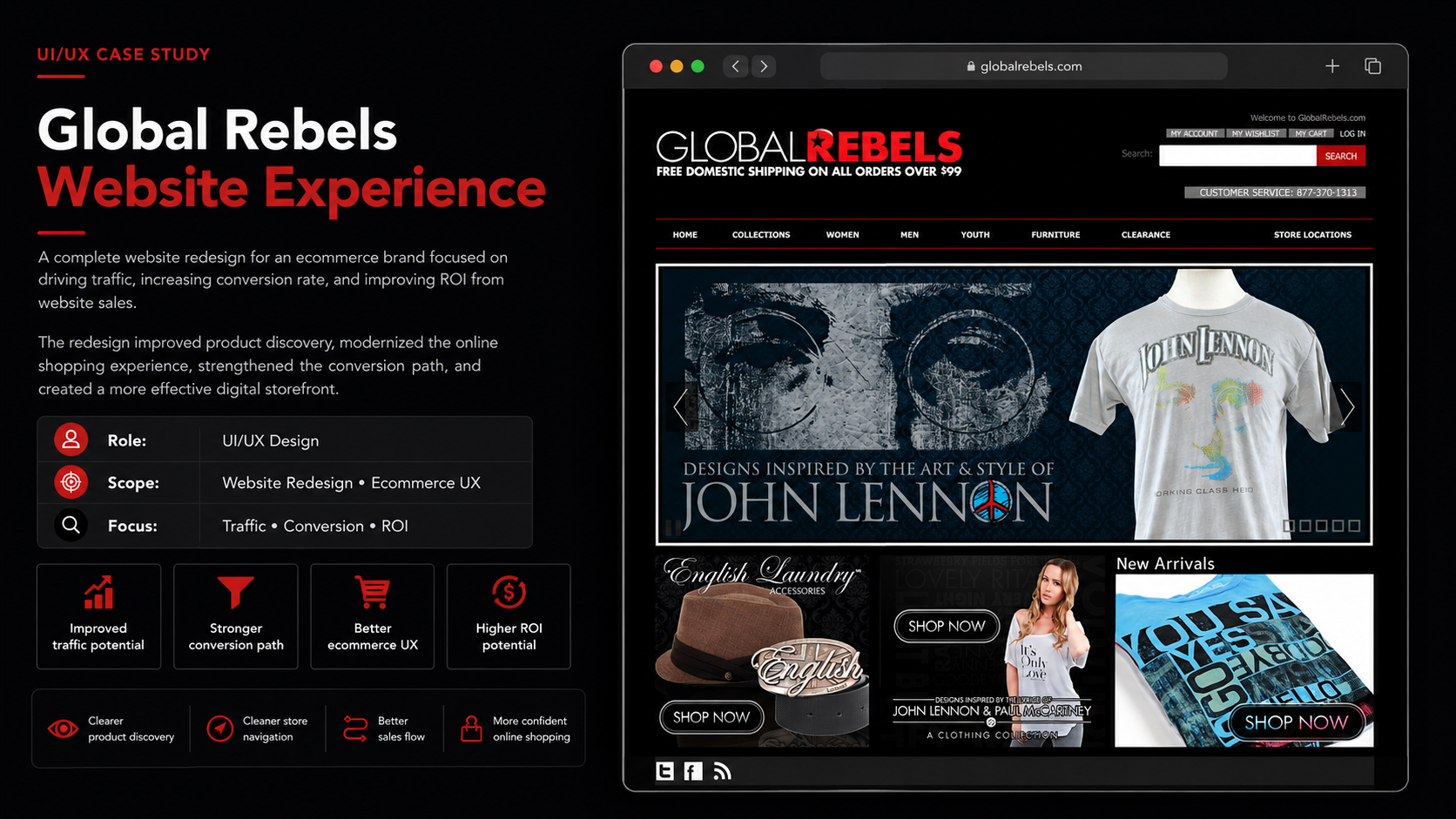
Global Rebels had a strong fashion identity, but the ecommerce site needed more active management to support product discovery, inventory movement, organic traffic, and customer purchase confidence.
The website became a more actively managed ecommerce channel with better product listings, improved merchandising, stronger SEO foundations, and clearer performance tracking through Google Analytics.
Project Overview
Global Rebels was an apparel manufacturing company led by fashion designer Christopher Wicks. The brand already had a strong creative identity, but the ecommerce website needed more active management to support product discovery, online sales, and inventory movement.
This was not a full end-to-end UX/UI product case study. It was a practical ecommerce website redesign and management project with key UI/UX decisions focused on improving the shopping experience, making products easier to find, and using SEO to increase website traffic.
My scope included website redesign support, ecommerce management, product listing, product photography, inventory updates, SEO, analytics tracking, and sales-focused content improvements.
Quick Context
Global Rebels needed its website to work harder as a sales channel.
The business had apparel products that needed to be photographed, listed, described, organized, and promoted online. The goal was not only to make the website look better, but to improve how customers discovered products, understood what was available, and moved toward purchase.
My work focused on supporting the ecommerce operation through better product presentation, clearer product information, SEO improvements, and Google Analytics tracking.
The project sat at the intersection of web design, ecommerce operations, merchandising, and light UX optimization.
The website needed to become less of a static brand presence and more of an active ecommerce sales tool.
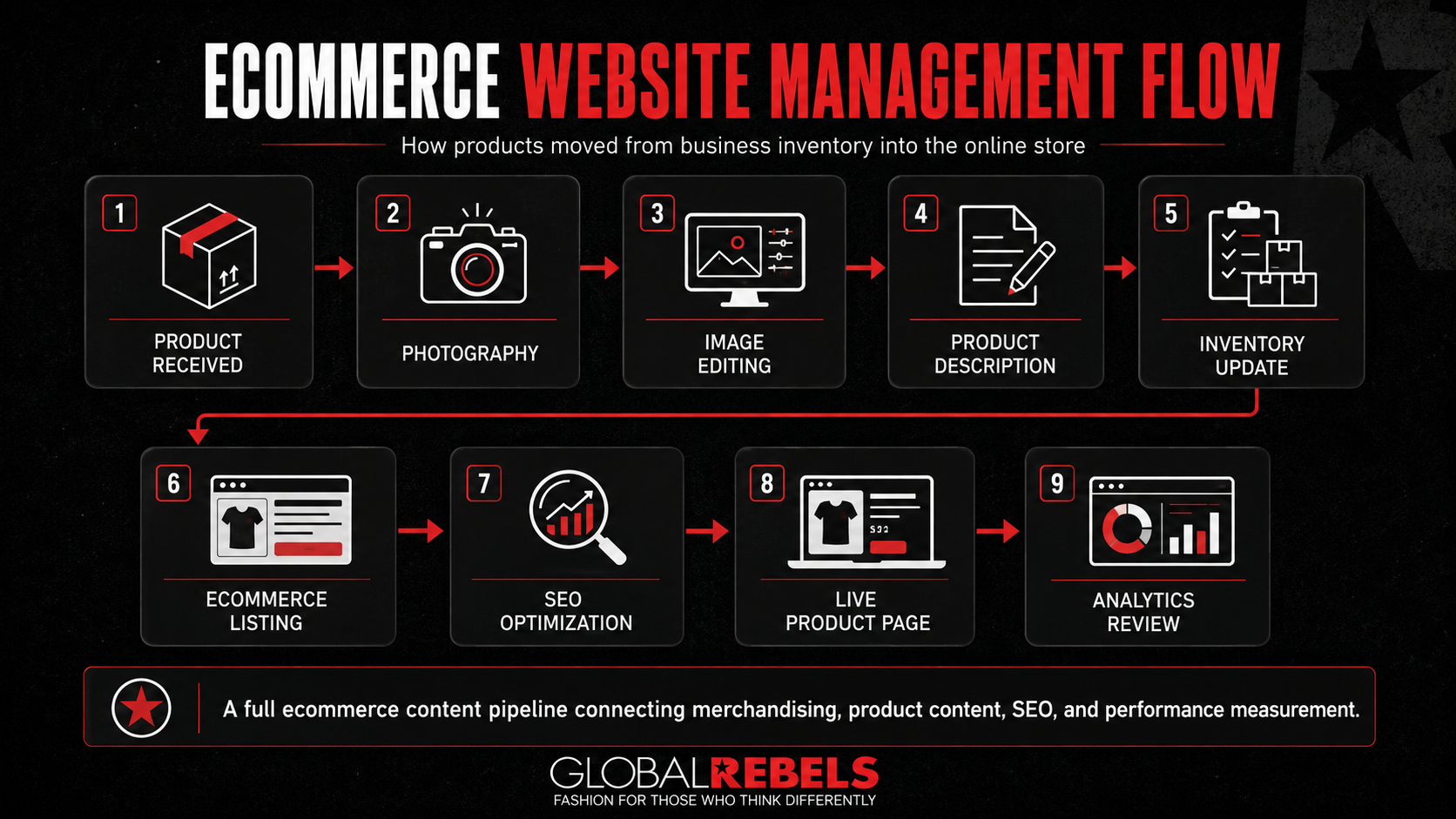 Ecommerce management workflow
Problems
Products Needed Stronger Ecommerce Presentation
Apparel ecommerce relies heavily on visual trust. Customers cannot touch or try on the product, so the website has to do the work of communicating quality, fit, style, and value.
Global Rebels needed new items photographed, listed, described, and organized in a way that made them easier for customers to understand.
The challenge was not only adding products to the site. Each product needed enough context to help customers make a decision.
This included clear product photography, accurate descriptions, inventory details, product naming, category placement, search-friendly content, and better merchandising structure.
Without strong product presentation, even good products could feel incomplete or difficult to buy online.
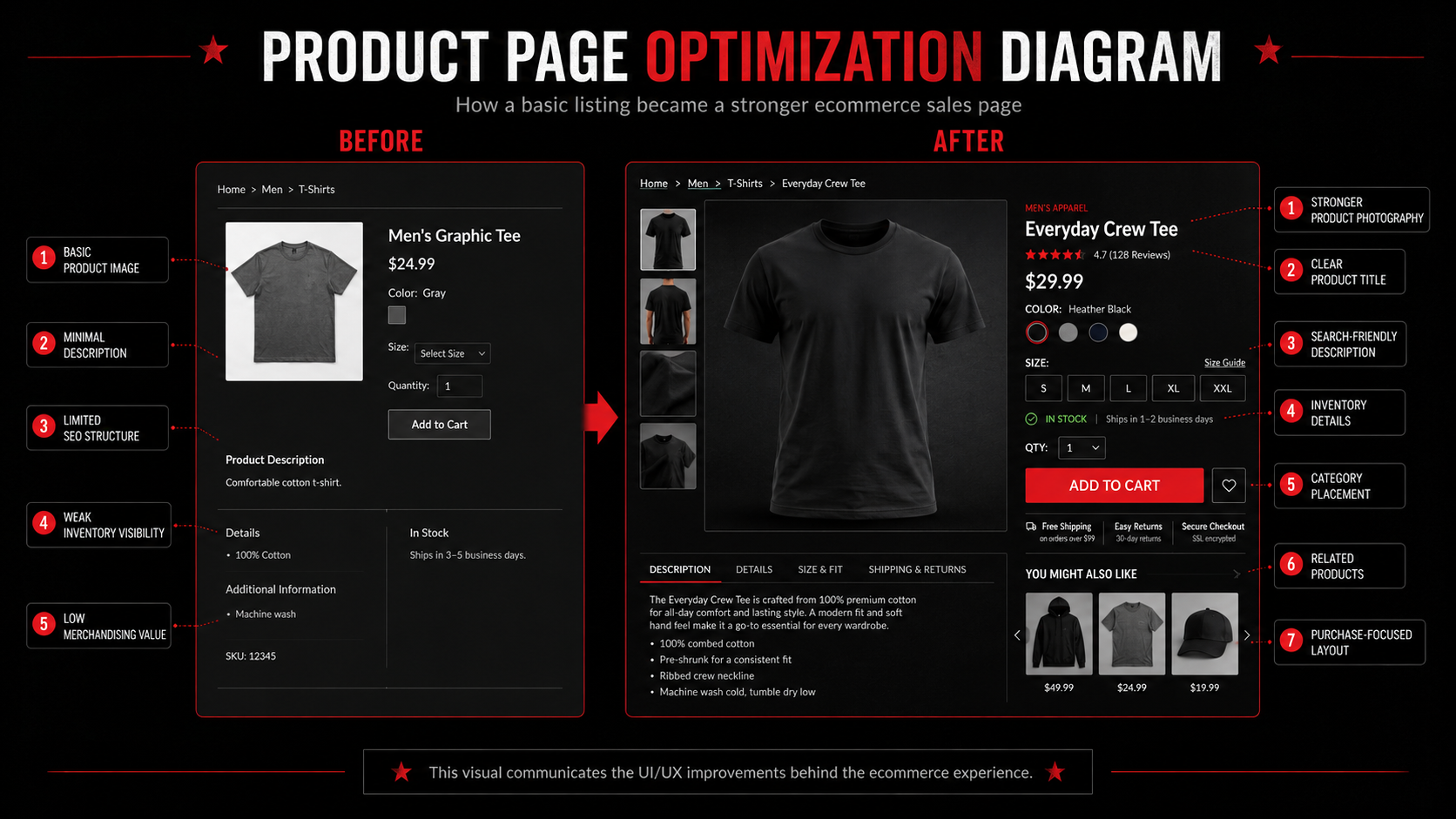 Product page optimization strategy
Older Inventory Needed Better Visibility
A common ecommerce issue is that older inventory can become buried behind newer products. If customers cannot easily find these items, they stop contributing to sales.
Global Rebels needed a way to push older inventory without making the site feel like a clearance bin or weakening the brand image.
The UX issue was visibility. Products that still had sales potential needed stronger placement, better content, and clearer pathways from browsing to purchase.
The business problem was inventory movement. Unsold items can take up space, reduce cash flow, and distract from newer collections.
The design problem was how to make older products feel discoverable, relevant, and still aligned with the brand.
SEO Needed to Support Product Discovery
The ecommerce site needed more organic visibility. Customers searching for apparel, fashion items, or brand-related terms needed a better chance of landing on relevant pages.
The website needed stronger SEO foundations, including search-friendly product titles, better product descriptions, optimized page metadata, improved category structure, more indexable product content, and clearer internal linking between products and collections.
For an apparel brand, SEO is not only about ranking blog articles. Product pages, category pages, and collection pages can all become organic entry points when structured correctly.
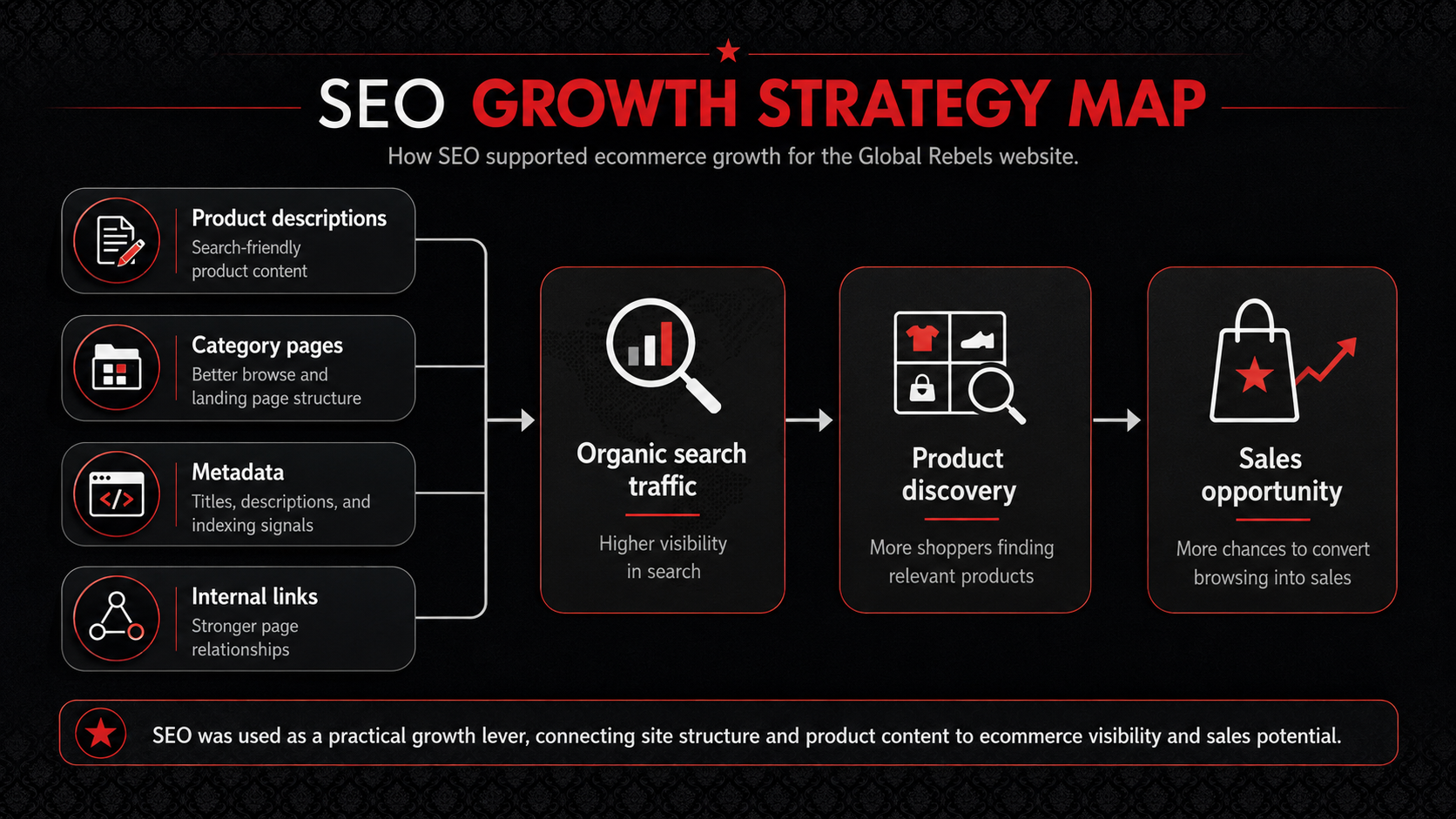 SEO growth strategy map
The Site Needed Better Measurement
Before making improvements, it was important to understand how users interacted with the site.
Google Analytics was used to monitor website traffic and understand whether SEO and ecommerce improvements were helping.
The key measurement challenge was connecting design and content work to business goals.
The site needed to answer questions such as:
- Are more users visiting the website?
- Which pages are bringing in traffic?
- Which products are getting attention?
- Are users finding new products?
- Are older inventory items receiving more visibility?
- Where are users dropping off?
- Which traffic sources are supporting sales?
Decisions
Treat Product Pages as Sales Pages, Not Simple Listings
One of the main decisions was to approach each product page as a small sales experience.
Instead of simply uploading an item with minimal information, the product listing process focused on making each item easier to evaluate.
This meant improving product photography, product titles, product descriptions, category placement, inventory accuracy, product visibility, and search relevance.
The goal was to reduce customer uncertainty. A stronger product page helps answer basic shopping questions before the customer leaves the site.
For apparel, this is especially important because the user is making a visual and emotional decision. The product page needs to communicate style, quality, and relevance quickly.
Use SEO as a Practical Ecommerce Growth Lever
SEO became one of the main ways to improve traffic.
The focus was on practical, product-level SEO improvements rather than a large content marketing campaign.
The SEO decisions included writing clearer product descriptions, using more descriptive product names, improving page titles and metadata where possible, organizing products into more useful categories, supporting discoverability through internal linking, and making product content more useful for both customers and search engines.
The goal was to increase qualified traffic, not just traffic volume.
Improve Merchandising for Both New and Older Inventory
The ecommerce experience needed to support two business needs at once:
- New items needed to feel fresh and visible.
- Older inventory needed to be easier to discover and sell through.
To support this, the site needed a stronger merchandising mindset. Product placement, category structure, and promotional areas were used to give inventory more intentional visibility.
Older products could be surfaced through featured product sections, collection pages, sale or promotion areas, related product placements, category updates, and better product descriptions and imagery.
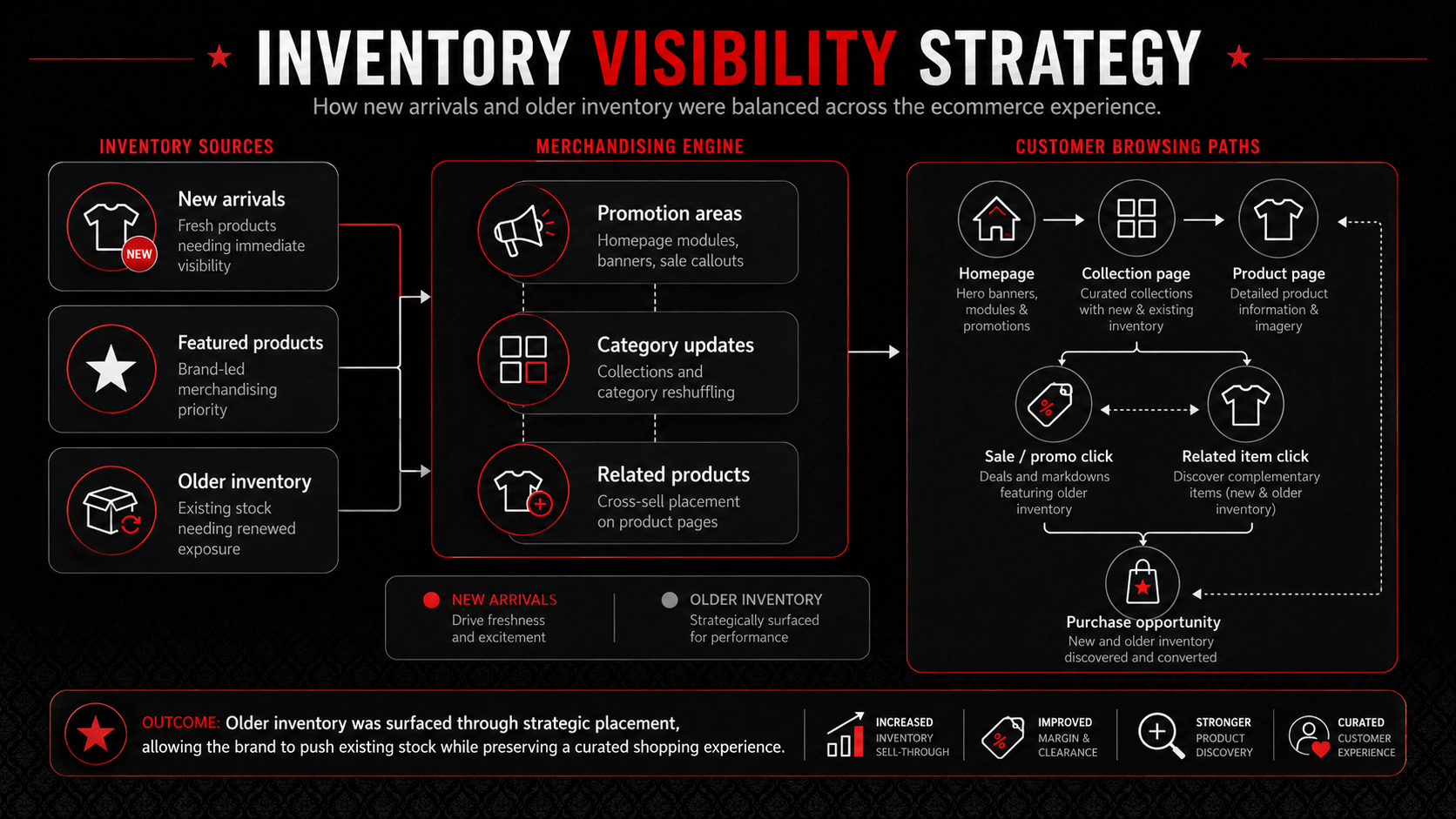 Inventory visibility and merchandising strategy
Use Google Analytics to Guide Website Improvements
Google Analytics helped turn the project from simple website maintenance into a more measurable ecommerce improvement effort.
Rather than making design changes based only on visual preference, the website could be reviewed through traffic and behavior patterns.
Useful measurement areas included website traffic, organic search traffic, top landing pages, product page views, user engagement, traffic sources, ecommerce behavior where available, and conversion paths where tracking allowed.
This helped connect website decisions to business outcomes.
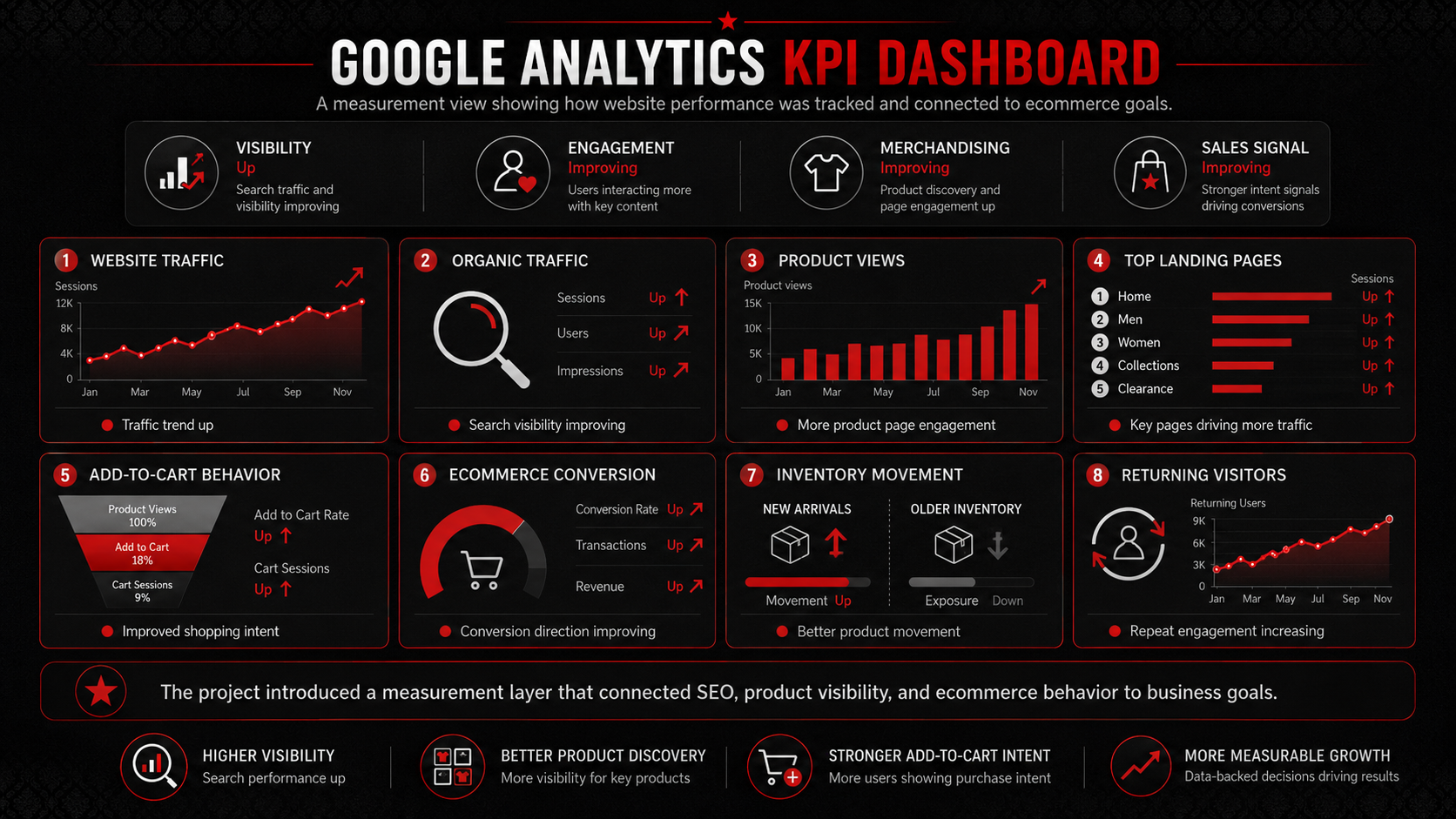 Analytics dashboard overview
Keep the Redesign Practical and Business-Focused
Because this was not a full UX/UI redesign, the priority was not to create a large design system or complete research process.
The priority was to make changes that had direct ecommerce value.
This included improving product presentation, supporting inventory updates, making pages easier to browse, improving search visibility, helping customers understand products faster, supporting sales goals, and measuring traffic through analytics.
The project was intentionally practical. Every design and content decision had to support the business need of selling apparel online.
Result
The Global Rebels website became a more actively managed ecommerce channel.
Instead of functioning mainly as a passive online catalog, the site was supported with product updates, improved merchandising, SEO-focused content, and analytics tracking.
Because exact performance numbers were not provided, the results should be presented as directional outcomes rather than hard claims.
Directional outcomes included:
- Improved product visibility through better listings and category organization.
- Stronger ecommerce presentation for new apparel items.
- Better support for moving older inventory.
- Increased focus on organic search traffic through SEO improvements.
- Clearer product content for customer decision-making.
- More measurable website performance through Google Analytics.
- Stronger connection between website design, merchandising, and sales goals.
KPI areas tracked or recommended included organic traffic growth, product page visits, top landing pages, bounce rate, add-to-cart behavior, ecommerce conversion rate, revenue by product or collection, traffic source performance, older inventory sell-through, and returning visitor behavior.
The biggest result was operational maturity. The website became more than a place to display products. It became a tool for product discovery, inventory movement, SEO growth, and ecommerce sales support.
Reflections
This project taught me that ecommerce design is not only about how a website looks.
For an apparel business, the customer experience is shaped by photography, descriptions, inventory accuracy, product organization, search visibility, and merchandising strategy.
A beautiful website can still underperform if products are hard to find, poorly described, or not connected to customer intent.
The biggest lesson was that ecommerce success depends on the connection between design and operations.
Product content, SEO, inventory updates, analytics, and visual presentation all have to work together.
In future ecommerce projects, I would want to add stronger measurement from the beginning, including clearer conversion tracking, product performance dashboards, and more structured A/B testing for product pages and promotional areas.
I would also recommend creating a lightweight ecommerce content system for every product launch, including photography standards, SEO rules, product description templates, and category placement guidelines.
This project showed me how even smaller website improvements can support larger business goals when they are tied to sales, visibility, and customer decision-making.